Describe the missing piece.
Tell us what the part belongs to and what it needs to do. Add a photo on your device to help you think it through.
A knob for the drawer I’m keeping.
A missing knob shouldn’t mean a new drawer. A replacement part starts with measurements, not guesswork. Give the thing you love another go.
Start a projectExplore the free preview. No account needed.
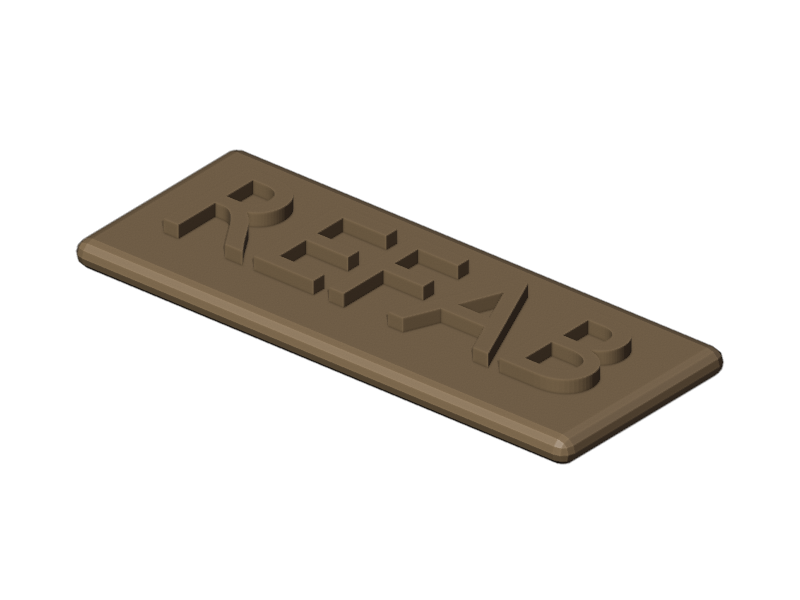 40 mm16 mm
Start with the small part that’s missing, rather than replacing the whole object.
Record the dimensions you can confirm. Keep guesses out of the project brief.
Explore a real sample with a checked mesh and a downloadable print project.
A clear brief comes first.
The right fit starts with the details.
Tell us what the part belongs to and what it needs to do. Add a photo on your device to help you think it through.
Record the overall dimensions in millimetres. Attachment measurements and material choices come before a final design.
Explore our tested sample now. Generating and reviewing a custom model is the next stage of development.
Actual generated geometry. Rendered in Blender.This little nameplate made the whole trip: a fixed design script, a checked mesh, and a sliced print file.
Verified locally on Linux. Print time and material are slicer estimates; this sample has not been physically printed.
3MF profile: Bambu Lab X2D · 0.4 mm nozzle.
Review the settings for your own printer.
Measuring, materials and the brief,
in plain language.
Callipers, datums and the four measurements that decide whether a part fits.
Read the guideWhere a 3D printed replacement part works, where it fails, and how to choose a material honestly.
The eight fields that turn "a small knob" into something buildable.
Three places obsolete spare parts still turn up, and when printing stops being safe.
Put the details in one place.
Make a measured project brief.
Create and download a measured project brief, add a photo preview on your own device, and download the tested REFAB sample. Automatic generation of a new model is not available yet.
Usually yes, for small low-load parts: knobs, dials, caps, covers, clips and spacers. It is a poor fit for parts that carry weight, seal gas or water, touch food, insulate mains voltage, or sit in a hot engine bay. Our guide to printing a replacement part walks through the cases where buying the official spare is the better answer.
Small knobs, covers, clips and spacers are our initial focus. This preview does not assess structural strength, electrical safety, food contact or other material requirements.
Start with the overall width, depth and height in millimetres. A fitting part will also need confirmed attachment dimensions and clearances. A photograph alone cannot provide those measurements.
No. In this preview, the photo is displayed only in your browser. The brief checker receives your description, selected part type and three measurements, without the image.
For a decorative cover, a millimetre either way rarely matters. For anything that clips, screws or rotates, the interface dimensions matter to within a few tenths of a millimetre, and printed holes usually print a little undersized, so they are often drilled or reamed to final size.
The STL can be opened in your own slicer. The supplied 3MF was tested with a Bambu Lab X2D profile and a 0.4 mm nozzle. Review and reslice for your own printer and material before printing.
Sometimes. Printed parts are weakest between layers and rarely match an injection-moulded original in impact strength. Orientation, wall count, material and the load path decide the result, which is why a brief should state what the part actually has to survive.
This public preview is free. There is no checkout, subscription or automatic charge. Pricing for future model generation has not been set.
Free to explore. Nothing to subscribe to.